
University of Richmond students twist their 21st century tongues around Shakespeare’s ‘The Tempest’
Student Experience
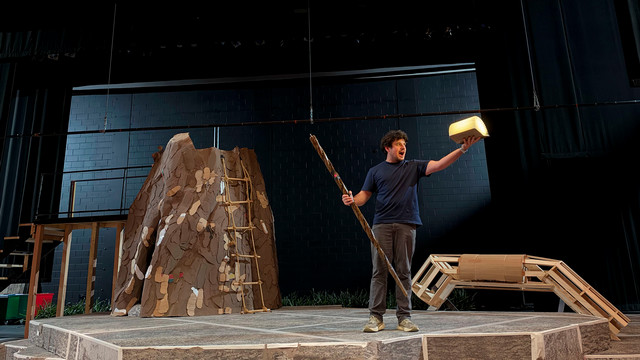
University of Richmond students have spent weeks preparing for the debut of their fall play The Tempest by diving deep into the meaning of William Shakespeare’s final play. The performances start Thursday, Nov. 12.
The Tempest tells the tale of a magician on a deserted island who summons a storm to shipwreck his enemies. JP Saurage, a sophomore from Louisiana, plays the lead, Prospero.
“I feel awesome playing the wizard,” he said. “I have a staff and a cloak – it’s very Gandalfesque.”
This is Saurage’s first-time preforming in a Shakespeare production. He got his first exposure to the playwright’s work in a Shakespeare acting class with Erica Hughes, the voice and text coach on The Tempest. Because he “really loved” the class, he auditioned for the fall production.
Eliza Varanelli, a psychology major who plays Ariel, another lead role, said she hadn’t had much theatrical exposure to Shakespeare outside of a high school performance of A Midsummer Night’s Dream.
“I thought it would be a really fun challenge to do The Tempest,” she said. “[It] has some of the dramatic elements that I’m not used to, and the comedic elements that I am. It’s a really fun challenge to mix those two.”
For a modern-day performer, the poetic but difficult language of Shakespeare doesn’t exactly roll off the tongue. Mastering and exhibiting the intention of his words is a daunting task and one of the biggest undertakings when performing his plays. Luckily, the student performers have faculty leading them through their journey into the world of Shakespeare.
Learning the lines, language, and characters
Hughes, a faculty member in the theater department, said that when helping the student performers learn and understand their lines, her biggest priorities are punctuation, flow, proper pronunciation, and definitions.
Students have to figure out how to unpack metaphors and language written back in the 17th century because “it’s almost impossible to memorize a line if you don’t know what it means,” she said.
One of her biggest challenges on this production has been helping the performers move from just understanding the text to bringing it to life.
“It doesn’t matter how much internal knowledge you have if you haven’t found a way to make it visceral and get [the audience] to understand the context of the scene, whether it’s supposed to be funny or tragic or romantic,” Hughes said. “You have to be able to play and explore and loosen up.”
Hughes said that young actors can have an “inferiority complex” about Shakespeare, but at the end of the day “it’s a story about a wizard on an island.”
Saurage said approaching his leading role was intimidating since Prospero has so many lines. In order to tackle his 20 pages of dialogue, he said he’s adopted two main methods.
“I have something called a cue script, which is the last character’s line then yours,” he said. “So all your focus is on your [lines] and no one else’s. There’s also this rhythm to Shakespeare where it’s like a heartbeat, and every phrase for a formal character like mine is 10 beats, so you can tell if you’re trailing off or if you’re missing a word in there, and so that helps.”
As Saurage puts in the hours memorizing his lines, he’s found something along the way: a connection to the past.
He said he’ll tie emotions to words and phrases, which helps him feel what the character felt but in a “completely different language.”
“It makes it a lot more powerful,” he said. “I find it so crazy that these people back then had the same ideas as us and the same complexities.”
Varanelli shared a similar experience with her character Ariel.
“There are revelations every day,” the junior said. “Every single scene that I do more than once is like ‘Oh, I understand this a little bit better.’”
Over the weeks Varanelli has spent learning and becoming her character, she said she has a different interpretation of Ariel now than she did at the beginning of the process and has even been able to apply some of her learnings to her own life.
“This is an old text, but there are some pieces in Ariel that I can find within myself,” she said.
A love for Shakespeare
For Saurage, working on The Tempest has opened him up to a world of Shakespeare. He described the play as “pretty complex” compared to others in the playwright’s catalog.
“There’s just so many characters, and there’s so many moving parts that once you get this down, all the others seem a bit more approachable,” he said.
And he hopes this won’t be the end of his time with Shakespeare.
“I really have fallen in love with it,” Saurage said. “Once I get the lines behind me, it’s going to be a lot more fun. I hope we do another one soon.”
The Tempest runs Nov. 12-15 at the Modlin Center for the Arts and is part of the UR Free Theatre & Dance series, an initiative created to remove economic barriers and make theater and dance accessible to everyone.