
Student-led debate brings more than 150 University of Richmond students together across political differences
STUDENT EXPERIENCE
Through thoughtful questions and respectful exchanges, students modeled productive dialogue.
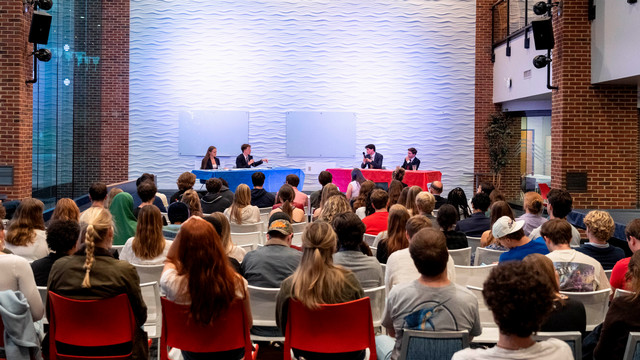
Working together, the University of Richmond’s Speech & Debate Team, College Democrats, and College Republicans planned a campus debate that put policy and ideas at the center. On Oct. 28, more than 150 students gathered in The Current in Tyler Haynes Commons to watch that collaboration unfold.
“Fundamentally, elections are about choices,” Daniel Palazzolo, professor of political science, said in his opening remarks. “And tonight you’ll hear answers to five really important questions and to what that choice is all about.”
For the student organizers, exploring those questions and choices together was an opportunity to demonstrate how people with different perspectives can have meaningful conversations. Before they made their arguments, the three organizations thoughtfully developed the structure, format, and questions, creating space for students to challenge one another’s positions while engaging respectfully across differences. It reflected their shared sense that how they talked to one another mattered as much as what they said.
“Speech & Debate wanted to host this event because, as an organization, we care about promoting free speech and public dialogue,” said sophomore Savannah Hollen, president of Speech & Debate and the evening’s moderator. “I think it's important to show that hard, potentially divisive conversations can happen on our campus, and that they can be respectful and productive.”
They found common ground on vital issues that affect our students on an everyday level.

At the evening event, the students put this idea into practice. Representatives of the College Democrats and College Republicans debated five timely questions spanning reproductive rights, energy prices, federal spending, election security, and presidential war powers.
The format and ground rules paired opening arguments with direct exchanges between the two sides. This structure gave participants opportunities to explain their positions, question opposing arguments, and respond to one another. Throughout the evening, students supported their arguments with data and posed thoughtful questions. They challenged each other’s ideas, actively answered questions, and identified areas of common ground.
The result was a debate that asked participants to do more than present a position. They also had to listen closely, consider different perspectives, and engage with the reasoning behind them. For the students watching, the exchanges offered an example of how passionate disagreement and productive dialogue can complement each other.
That spirit carried into the closing moments, when each participant shared something they appreciated about the other side. After an evening spent examining their differences, students ended by recognizing one another’s contributions to the conversation. The Speech & Debate Team closed with an encouragement to students to vote and use their voices.
“Our students modeled civic discourse that requires careful listening, consideration of complex perspectives, and evidence-based arguments, and they found common ground on vital issues that affect our students on an everyday level,” said Tim Barney, a rhetoric and communication studies professor and the UR Speech & Debate team’s faculty adviser. “They care and think deeply about the consequences of political division in their generation. Despite substantive differences, both teams demonstrated the promise of a more collaborative future.”