
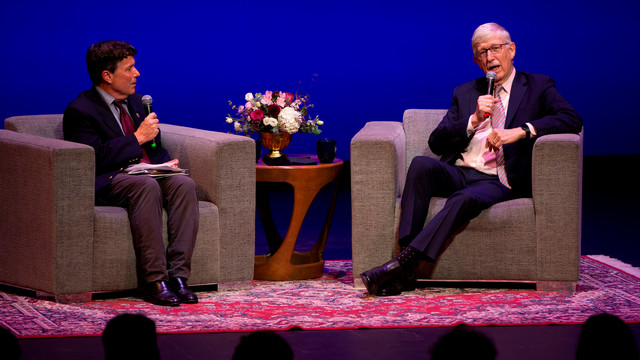
University of Richmond lecture on medical research ‘could not be more timely’
University News
We are in “a golden age of opportunity for health sciences students,” Dr. Francis Collins told guests at the 39th annual Weinstein-Rosenthal Forum on Faith, Ethics & Global Society, hosted by the Chaplaincy.
Collins, who led the Human Genome Project and National Institutes of Health, made the claim during wide-ranging remarks about his career and new discoveries in genomics, stem cells, AI, and precision medicine. His talk was titled “Medical Research Advances in 2026: The Best of Times, The Worst of Times.”
“Biomedical research is on a roll,” Collins said. “CRISPR gene editing has transformed the microbiology lab.”
Groundbreaking DNA research
Collins first learned about what he called “the most awesome chemistry ever — DNA” while pursuing his doctorate at Yale, he said. His desire to use this knowledge to help patients inspired him to pursue his medical degree at the University of North Carolina at Chapel Hill.
One of his early career accomplishments was heading a research team that helped discover the gene responsible for 90 percent of the cases of cystic fibrosis.
“Most [patients] were just missing three letters out of three billion DNA pairs,” he said.
The pioneering research ultimately led to an approved treatment for cystic fibrosis, the oral medicine Trikafta.
Collins directed the International Human Genome Project from 1993-2003, leading a team of over 2,500 scientists from around the world. The team completed a map of human DNA sequencing in 2003, which has allowed for the rapid development of treatments for genetic diseases.
More recent advances he discussed include individualized mRNA vaccines for melanoma and soon for other cancers, the curing of sickle cell disease, stage 4 cancers in remission, and people with type 1 diabetes living without insulin after stem cell therapy.
Collins has also examined the relationship between science and faith. One of his books, The Language of God: A Scientist Presents Evidence for Belief, was a New York Times bestseller. Collins “sees wisdom, faith, science, and trust as a means to move past polarization — a conversation that could not be more timely,” University Chaplain Rev. Craig Kocher said in his introductory remarks.
Moving past polarization
In recent years, the country’s polarization has had a chilling effect on progress, Collins cautioned. He said he saw it firsthand while serving as director of the NIH during the Covid-19 pandemic.
Today, political decisions are overruling peer reviews, and public funding for scientific studies has been slashed.
“In 2026, it’s deeply troubling what’s happening to major medical research,” he said.
A new nonprofit he started, Discovery Lives in Us, shares patient stories to help educate the public about the importance of funding for medical discoveries.
“I don’t think our polarization is going to get solved by politicians,” he said. “It’s got to be a ‘We the People’ thing.”
After the lecture, biochemistry and molecular biology major Lauren Shin shared her reflections.
“My dad is an endocrinologist, and he used to talk about Francis Collins and how he was really a change maker with the Human Genome Project,” she said. “And then I did my own research with reading his book, The Language of God, and it helped me connect a lot of the ideas I was learning in the classroom with my own personal faith.
“Getting to see him in person after hearing about him so much from my dad and reading his books is so amazing.”