
University of Richmond students learn from a Broadway and Hollywood legend
STUDENT EXPERIENCE
Paul Tazewell, who designed costumes for Hamilton, Wicked, and West Side Story, shared stories and answered questions about his groundbreaking career.
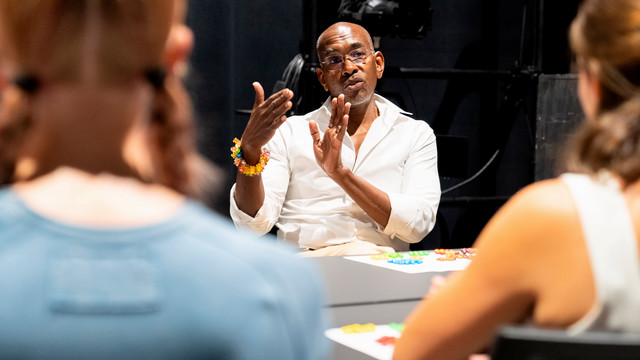
Oscar, Emmy, and Tony Award-winning costume designer Paul Tazewell — dressed in an immaculate, perfectly tailored white shirt — joined a dozen students from the Lighting Design class last week for an activity that had them sorting M&Ms and Skittles by color.
A charm bracelet dangled from his wrist as he slid the candies into piles.
“I like your bracelet,” Mary Kimbrough, a dance and political science major, said, leaning in for a closer look. “It’s gummy bears! That’s so cute!”
Tazewell’s spot-on accessory for sorting candy was no surprise. This was, after all, the visionary designer behind the 18th-century-with-an-edge costumes in Hamilton and Glinda’s pink-beaded bubble gown and Elphaba’s sculptural hat in Wicked.
Tazewell started his career on Broadway after studying at New York University Tisch School of the Arts and later expanded to the big screen. His designs have earned him the most prestigious honors in his field.
The class activity was part of a full, two-day schedule that included A Conversation with Paul Tazewell the night before, sponsored by the theater and dance department, and smaller gatherings with Richmond students.
Theater professor Maja White adjusted colored lighting between four candy sorting exercises, playing tricks on the eye. The class expressed surprise at their color misperceptions whenever she turned on an overhead light.
“We use light and pigment to fool our audience,” White said.
The class peppered Tazewell with technical questions, including how color differs when working with digital film (Wicked) compared to celluloid (West Side Story). Color appears more vibrant at first on celluloid, he said, while digital film is later enhanced in production.
Tazewell had a question for White. “In my experience, there have been times when a scene has been lit with a lot of amber. It quickly muddies the picture, which takes away lots of detail. What’s happening there?”
“Amber diffuses color,” she said. “Lavender helps pull the color out.”
Creating an open, collaborative environment
After the sorting activity, students asked whether he had always known that he wanted to be a costume designer. He explained that he started out also as an actor, singer, and dancer, often designing costumes for his productions as well. At Tisch, he had to choose between the two tracks and saw more opportunity and greater career longevity in costume design.
“At the time … I didn’t see many people of color in principal roles or stories that centered on people of color,” he said.
Paul Tazewell became the first Black man to win an Oscar for Costume Design in 2025 for Wicked. He’s also a two-time Tony winner for Hamilton and Death Becomes Her.
He’s watched the industry move toward becoming more collaborative, supportive, and open.
“It’s imperative to feel safe to do the creative investigation that any production requires, especially when you’re trying to do something exciting and break [new] ground,” he said. “And it resonates from the top down and out.”
Senior David Hensley, an actor who is a theater and math economics double major, was surprised to learn that costume design for films like Wicked includes an extensive predesign, preproduction, and on-site process.
“I don’t think you think about that,” he said. “You think about the actor on the stage. It made me appreciate [the design work] when he was talking about their process starts 12 months before ours.”
Hensley, who attended the conversation event the night before, was surprised to be able to sit down with Tazewell in such a small group setting.
“It was intense,” he said. “He’s done so many amazing things, and getting to ask someone questions who’s at the top of their craft in their field is super insightful.”