
The Odyssey gives University of Richmond faculty new questions about an old classic
RESEARCH & INNOVATION
Christopher Nolan’s 21st-century spin on the ancient Greek poem offers new discussion points for Spider classrooms. Professors explain their takes.
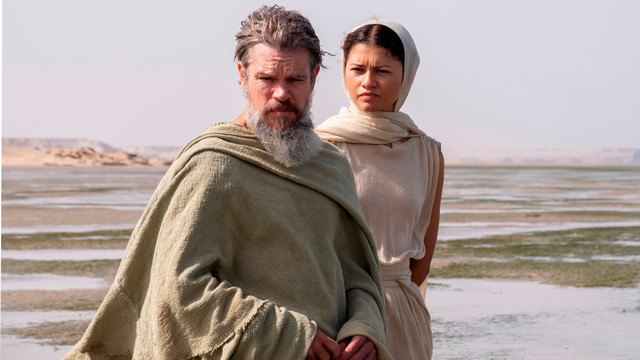
The timeless tale of a mortal king challenged by the gods as he tries to return to his family and kingdom finds its latest incarnation in Christopher Nolan’s summer film, The Odyssey. For UR professors, the blockbuster is providing a fresh path for connecting students with Homer’s epic poem and exploring its lessons for our time.
Classics professor Anastasia Pantazopoulou, who has seen the film twice, said ancient texts are meant to be interpreted and discussed over time.
“Nolan’s Odyssey is the latest contribution to a conversation with Homer that has been going on for centuries,” she said. “I am excited for my students to become part of that conversation.”
Here’s a sample of how she and other professors will be using The Odyssey for student learning beginning this fall.

A wounded veteran
Students in Pantazopoulou’s Classical Mythology class this fall will study both the book and the film, “to explore what Nolan preserves, changes, omits, or reinvents, and what those choices reveal about the concerns of modern audiences,” she said.
“What I find particularly interesting is the kind of Odysseus the film constructs: in many ways, a wounded veteran whose experiences of war and homecoming speak to contemporary anxieties and ethical expectations.”
She explained that qualities that an ancient audience might understand within a particular heroic code — cunning, violence, ambition, endurance, and the pursuit of glory — look quite different to a modern audience.
“The film gives us an opportunity to ask not simply, ‘Is this Homer’s Odysseus?’ but ‘What kind of Odysseus does our own cultural moment need, admire, question, or find troubling?’”
War as a change agent
Leadership studies professor Chris von Rueden says the film’s references to sea peoples and the end of the Bronze Age connect with questions about how institutions, including forms of government, systems of trade, rule of law, and religion, get built, spread, and unravel.
“War was often a key mechanism of institutional change, whether because victors spread their institutions or because the institutions of the loser were incorporated, suppressed, or destroyed,” he said.
He plans to discuss these topics as explored in the film with students in his Sex, Leadership, and the Evolution of Human Societies class this fall. In addition, students will read the mathematical historian Peter Turchin, who highlights the role of conflict between “barbarians” such as the sea peoples and agrarian states like the ancient Greeks. In his work, Turchin echoes the concerns in The Odyssey that decaying values and other internal reasons made Greek societies more vulnerable to being overrun.
“These reasons include things like proliferation of elites and declining citizen wellbeing,” von Rueden said.

The journey home
For Lidia Radi, a professor of French and Italian studies, the film offers a framework for exploring what she believes is one of the most enduring human questions: How do we find our way home to ourselves? Radi plans to discuss this aspect of the story in two courses: her First-Year Seminar called Friendship, Love and Desire and her senior seminar called What Are the Liberal Arts For?
“While Homer's epic recounts Odysseus' long journey back to Ithaca, I will invite students to consider `home’ not merely as a place to which one returns, but as a state of being achieved through self-examination,” she said.
Odysseus' physical journey is inseparable from his moral one, she added. “In this sense, the return home is not simply a return to where he began, but a return to a wiser self — one transformed through questioning, relationships, and the lifelong pursuit of wisdom.”
Coming this spring
- Classical studies professor Nicholas Baker will structure his class Classical Tradition around The Odyssey this spring. “Nolan's Odyssey is all about today,” he said. “His Odysseus is not Homer’s but is an Odysseus for the early 21st century: a man haunted by guilt for his own role in betraying the moral fabric of a culture, for his complicity in a war that was not worth the human cost, for his contribution to civilizational collapse. This is a film that speaks to contemporary issues and debates.”
- Classical studies professor Jorge Wong Medina, who teaches The Odyssey in Greek as well as in translation, believes that modern interpretations of ancient materials are critical to drawing young minds to the discipline. “Students cite a variety of works as inspiration for their study of classics: movies like Nolan’s Odyssey, musicals like Hadestown, video games like Assassin’s Creed: Odyssey and Hades, and novels like Madeline Miller’s Circe and Rick Riordan’s Percy Jackson,” said Wong Medina, who will incorporate the movie in his Ancient Myth in Epic Poetry class this spring.
- Classics and archaeology professor Elizabeth Baughan plans to discuss the accuracy of the depiction of Troy in the movie in her spring class, Archaeology of the Middle East. “Students doing summer research in Classics have been talking about the film,” she said. “The best part of seeing the movie, for me, was witnessing how many people in the theater were clearly excited by this ancient story.”