
University of Richmond summer lab chronicles: How babies learn words and people form memories
STUDENT EXPERIENCE
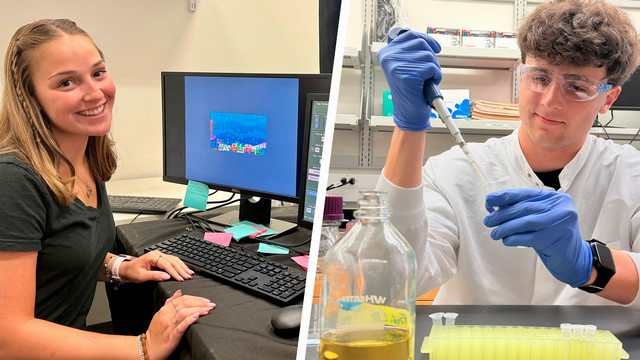
By studying how toddlers learn new words and how proteins help form memories, University of Richmond students Tessa Katz and Caleb Fausnaught are spending the summer investigating questions at the heart of how people learn. Supported by UR Summer Fellowships, the rising seniors are gaining hands-on experience that reaches beyond the classroom while contributing to scientific discovery.
For Katz, a psychology major and education and society minor from Cranbury, New Jersey, that means spending her days at Princeton University’s Baby Lab, where researchers explore how young children acquire language.
“I have always been interested in how kids grow and learn,” she said. “My passion for developmental psychology grew after I spent last summer working in a different developmental psychology lab.”
Working with children between 24 and 36 months old, Katz helps conduct eye-tracking studies that measure how toddlers learn new words under different listening conditions. As children watch a video, researchers track where they look after hearing made-up words in clear and muffled conditions. The lab also records play sessions to better understand how both children and their caregivers refer to familiar and unfamiliar toys.
Her early observations have reinforced some expectations while challenging others.
“Children seem, as one would have expected, to learn language best when the person using the word speaks clearly and articulately,” Katz said. “However, I have been surprised by how often the kids have been able to learn the words in the muffled condition.”
Working with toddlers requires flexibility.
“In order to track the kids’ eyes, they need to wear a sticker on their forehead so the camera can focus properly,” she said. “These kids are really young and love to move around, so it isn’t infrequent that they stop paying attention, wiggle too much, or even cry during the video.”
Through practice, Katz has learned how to keep children comfortable and engaged for six-minute stages while maintaining the study’s integrity. The experience has also offered a firsthand look at graduate-level research as she considers pursuing a doctorate.
On the University of Richmond campus, Fausnaught is exploring a very different aspect of learning: the molecular processes that help memories form.
The biochemistry and molecular biology major with a neuroscience concentration is spending his second summer in biology professor John Peters’ laboratory. His research examines how a protein called SNAP-47 contributes to communication between neurons, work that could eventually deepen understanding of memory formation and neurodegenerative diseases.
“Our research is interesting because it plays a role in our understanding of the mechanisms behind memory formation, combining wet-lab biochemistry and computational research to answer our questions,” said Fausnaught, who is from Williamsport, Pennsylvania.
His work ranges from using noninfectious E. coli as a “factory” to produce SNAP-47 to imaging neuron-like cells with a confocal microscope.
“My days look very different depending on what I have planned,” he said, noting that the skills he’s gaining in reading and communicating complex science will be critical in his planned career as a physician. “Every day, though, is always interesting, whether it’s taking pretty pictures of cells, working with E. coli, or catching up on the cool projects everyone else is working on.”
After spending much of last summer troubleshooting and building a foundation for the project, Fausnaught said the team is now seeing results.
“My project has given a lot of evidence toward the structure predicted by the Nobel Prize-winning AI, AlphaFold,” he said. “This portion of the protein can give us insight into how it regulates memory formation and why it’s so unique compared to the other proteins involved in this process.”