
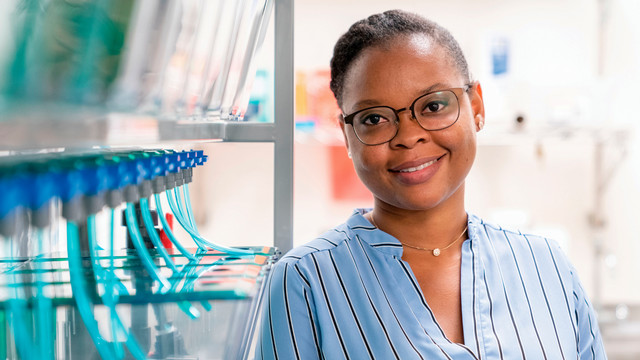
Zebrafish — and student researchers — are helping a University of Richmond biology professor advance pediatric epilepsy research
RESEARCH & INNOVATION
“Science often moves forward in small steps,” says professor Colleen Carpenter-Swanson.
For children with epilepsy, seizures are only part of the challenge. Many also face learning and social difficulties, problems most treatments do not address.
University of Richmond biology professor Colleen Carpenter-Swanson is motivated to close the gap between scientific discovery and the needs of patients. And she’s using one of the smallest creatures in biomedical research to do so.
Carpenter-Swanson studies children with pharmacoresistant epilepsy, meaning their seizures do not respond to currently available medications. While seizures are the hallmark of epilepsy, she noted that cognitive delays, motor dysfunction, and social challenges can have a great impact on daily life.
Her research centers on zebrafish, a widely used research model known for its distinctive horizontal blue stripes. For Carpenter-Swanson, they are a dependable test subject that are also affordable and approachable for her students.

By modeling the genetic changes associated with epilepsy, her lab observes how these changes affect the brain and behavior and then screens potential drug treatments at a scale and cost that traditional models don’t allow.
“We’ve been able to show that the fish can mimic not just seizures, but the other disorders that come along with them,” said Carpenter-Swanson. “Now we have a platform to look for compounds that treat the whole disease.”
Her work has earned support from the LGS Foundation and the STXBP1 Foundation to fund her ongoing research into severe childhood-onset epilepsies. In 2025, she was named to the Serve Virginia Honor Roll in recognition of her service to the state and the University.
Carpenter-Swanson says the students she works with at UR are central to the research she conducts. In 2026, her work resulted in a peer-reviewed publication in Frontiers in Pharmacology, co-authored with 2024 graduates Kharma Hall and Olivia Beatty.
Beatty said her career trajectory shifted inside Carpenter-Swanson's lab. She’s currently completing a master’s degree in genetic counseling at Cincinnati Children’s Hospital Medical Center.
“She didn’t teach us what to think — she taught us how to think,” Beatty said.
She recalled one week when Carpenter-Swanson paused lab work to help her map out post-graduation plans. “I truly never would have gotten here without Dr. Carpenter’s unwavering support, mentorship, and kindness, and a canceled lab experiment,” Beatty said.
That commitment defines Carpenter-Swanson’s lab culture. She fosters collaboration and maintains close ties with alumni, connecting past and current students as they navigate their careers.
“My grand hope is to find a novel treatment that offers patients a better quality of life,” she said. “But science often moves forward in small steps. My realistic hope is adding information to the field that somebody else can build on, and ultimately — maybe 10 labs away — contribute to a change in available therapies for patients. Every piece of knowledge we add gets us closer to better treatments for children who need them. I just want to add to the body of knowledge that’s out there.”