
Summer STEM matches hosted by University of Richmond
STUDENT EXPERIENCE
Last Friday, the Gottwald Science Center came alive as students competed in field games with a decidedly scientific twist. “Excited Electrons,” “Hungry Hungry Macrophages,” and “Petri Dish Relay,” were among the events stirring up excitement. About 125 students took part in the half-day event, sponsored by the Science Belonging Committee, and now in its 13th year.
“Six weeks into the summer research, we wanted to have a fun way to bring the students together, as a reward for all their hard work,” said biology professor Priscilla Erickson.
Students wore t-shirts representing their individual labs, such as Leo’s Fierce Lions, an homage to chemistry professor Michael Leopold.
Some arrived with dramatic flair. The Squeaky Blinders team painted their faces like laboratory mice, while wearing wool driving caps popular in the British drama series, Peaky Blinders.
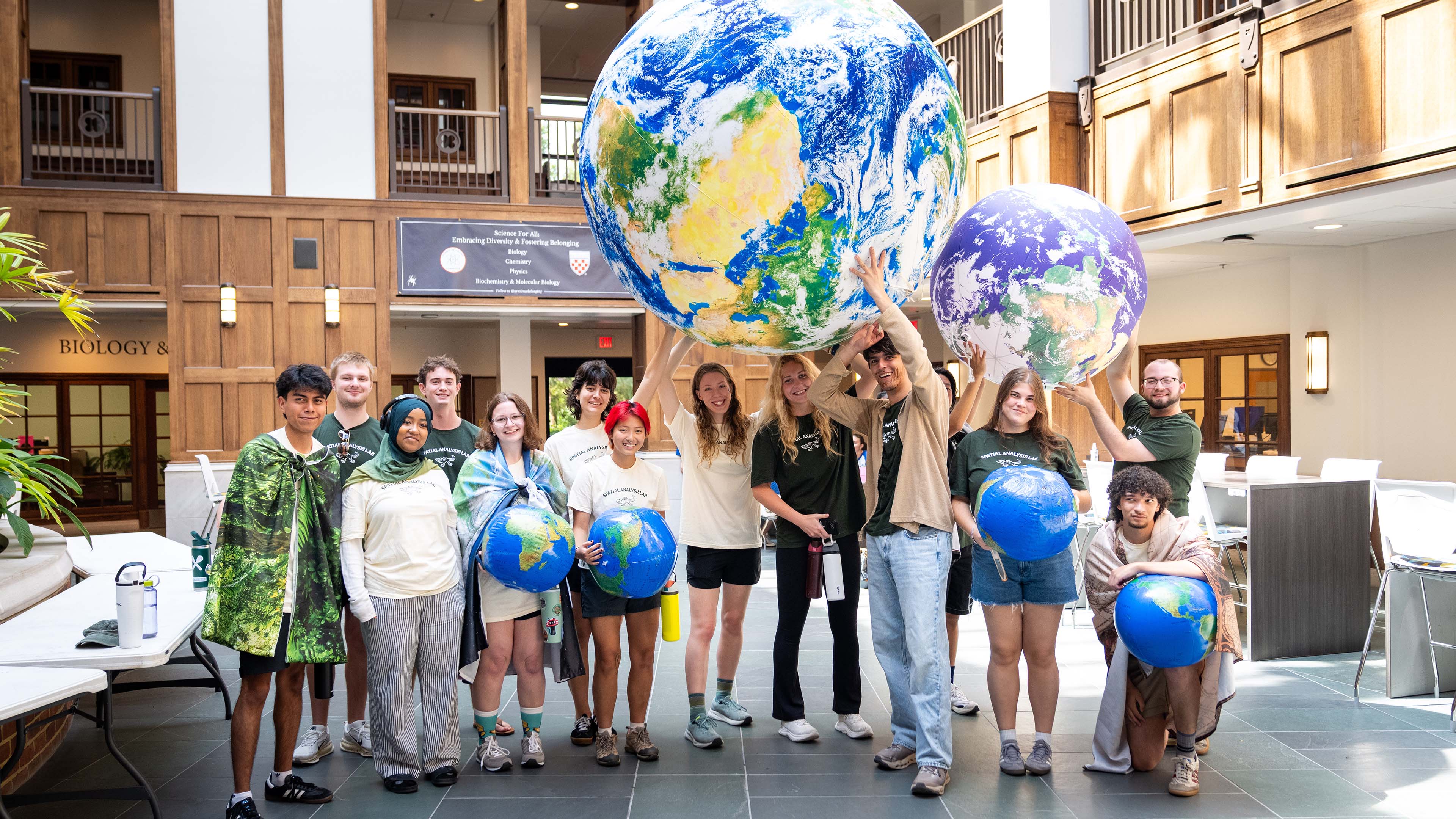
Hays Stritikus announced the arrival of the Spatial Analysis Lab’s team by rolling a towering globe to the events.
“We’re all the way over in the international center, so we’ve got to bring part of the department with us, because the other teams have a home-team advantage here,” said Stritikus, a senior majoring in political science and geography. He ducked behind the globe as water balloons splashed around him from the “Excited Electrons” game.
For “Brain Ball,” students tossed bean bags in a cornhole style game while wearing vision-impairing goggles.
Students balanced a stack of petri dishes in a relay that had them hopping, sitting, and walking backwards.
“It’s okay, it’s okay, shake it off,” urged one student, as a teammate’s tower clattered to the ground.
In one classroom, chairs were cleared away and tables were placed on their sides creating a holding pen.. Teams competed in a human-sized version of “Hungry Hungry Hippos,” in which a student lays on a board and is rolled in and out of the arena as they try to collect as many balls as they can with a bin. Halfway through the game, biology professor Colleen Carpenter-Swanson threw in some bonus rubber ducks, which netted 10 points each.
Physics professor Christine Helms, one of the organizers, explained the name change from hippos to microphages.
“Microphages are cells that engulf invaders like bacteria,” said Helms. “Similarly, the students are capturing things, or engulfing them, so to speak.”
Some events required more brain than brawn, such as “Memory,” where students had to replicate the colors in a 96-well plate after looking at it for just a minute, or “Geo-guesser,” a computer game where they had to guess the locations of scenes around the world.
“They’re incredible,” said Stritikus, of the games. “It’s a fun way to come together to celebrate all the great work that happens on campus in the summer.”