
University of Richmond launches digital tool to map humanity’s genetic past
RESEARCH & INNOVATION
Thousands of years before written history, humans were on the move — migrating across continents, forming communities, and interacting in ways that would shape human’s genetic story. Now, thanks to a new interactive tool developed at the University of Richmond, anyone with an internet connection can explore that story.
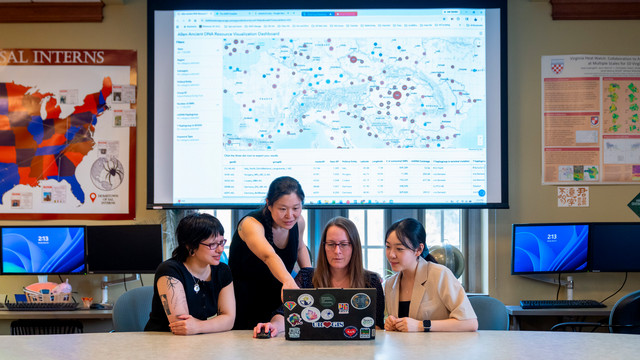
The interface, called the AADR Visualizer, transforms one of the world’s largest ancient DNA datasets into a free, interactive public resource. Developed by biology professor Melinda Yang and geography professor Stephanie Spera, the tool maps more than 17,000 individuals from the Allen Ancient DNA Resource, a widely used public database of ancient human genomes.
In recent years, advances in sequencing technology have dramatically expanded what researchers can learn from ancient DNA. But as the field has grown, so has the complexity of its datasets.
“Ancient DNA research has exploded,” Yang said. “But the data can be difficult to navigate without technical training. Our goal was to make this incredibly rich resource visually accessible and intuitive, not just for specialists, but for students, educators, and curious learners everywhere.”
The visualizer allows users to apply a series of filters, including by geographic region, age, and population group. Clicking on a specific location reveals sample-level details, metadata, and links to the original scientific publications. The platform requires no specialized software and is fully open to the public.
For Spera, the project reflects the strengths of a liberal arts environment where disciplines intersect naturally.
“Studying human history related to where people lived and how they moved is a natural marriage for biology and geography,” said Spera. “This work highlights one of my favorite things about UR, which is how our collegial, collaborative environment naturally fosters and champions interdisciplinary work.”
Beth Zizzamia, manager of the University’s Spatial Analysis Lab, helped guide the technical development, while undergraduate researchers Flora Yi (Class of 2027) and Elliot Delroba (Class of 2024) contributed to data organization, interface design, and testing.
“Giving students the chance to contribute to a publicly released scientific platform is part of what makes Richmond special,” Zizzamia said. “Their work isn’t hypothetical. It’s out there, being used.”
For students, the experience offered more than classroom learning. It provided hands-on exposure to genomics, geographic information systems, and digital storytelling — and the opportunity to help build a tool with global reach.
“Having studied ancient human DNA since my first year in college, I experienced how challenging it can be to absorb all necessary background information and conduct comprehensive analyses. I was interested in this project because I thought this could lower the barrier to entry in ancient DNA studies for other young scientists,” said Yi, a biology and computer science double major with minors in mathematics and data science & statistics.
Delroba graduated with a major in biology and a minor in data science & statistics. She is currently working as a quality control analyst and said her work on this project has inspired her aspirational career goals.
“I learned I really enjoy working with geospatial data even more than I thought I did. I would love to work in GIS, and specifically, if I can find an opportunity that blends geography and biology as I have working on this project, I would jump at it.”