
University of Richmond alum focuses his care on older patients
ALUMNI
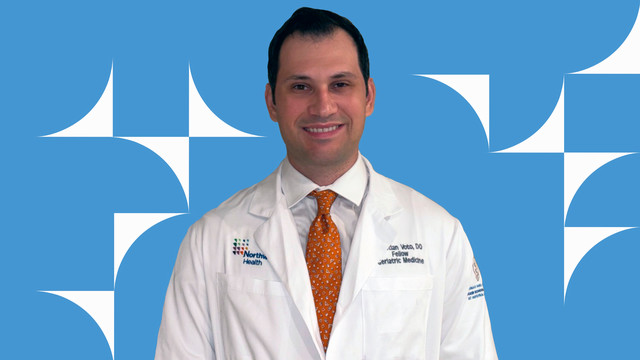
Dr. Christian Voto, a 2016 UR graduate and geriatrician based in New York City, is working to improve healthcare access for older adults, often by bringing medical care directly to their doors. He offers house calls, office visits, and hospital work. Voto has firsthand experience with the gaps and barriers that older patients face — even in a major city with thousands of medical providers.
“There are many people aging alone in Manhattan, with no family or social support,” he said. “They end up caught in a cycle of repeated hospitalizations and discharges to rehab. The system isn’t equipped to handle this aging population.”
In some ways, he’s continuing the work he started over a decade ago, including his role in the “Kitty Hawk moment” for medical drones.
Drone delivery
“I’ve wanted to be a doctor for as long as I can remember,” Voto said. “I have photos of me as a toddler wearing a stethoscope and a doctor’s coat.” By high school, he was shadowing physicians and laying the academic groundwork for medical school.
In 2015, when Voto was studying biochemistry and business administration at Richmond, his mother came across an article about the Health Wagon, the nation’s oldest mobile health clinic. The Health Wagon provides free primary, specialty, dental, and vision care to underserved patients in rural Virginia. George Hiller, an adjunct professor of liberal arts, was building a partnership between the University and the clinic, and they were seeking students to get involved.
“I was gung-ho about medical school, but it’s hard to take the MCATs, complete your classes, and build a resumé,” Voto said. “My mom was looking for something that would help strengthen my applications.”
Voto applied for an internship through the Civic Fellowship program and became “the first in a continuing line of UR student volunteers and interns at the Health Wagon,” Hiller said.
Much of Voto’s work that summer involved preparing for Remote Area Medical, a pop-up clinic in Wise, Virginia. That year, the Health Wagon was also testing a new drone-delivery system to improve access in hard-to-reach communities and deliver medications. Voto recruited 30 patients to participate and arranged for their medication deliveries.
“We wanted to find patients who were connected to the Health Wagon in some capacity but were at high risk of falling through the cracks of the medical system,” Voto said. “They may have missed appointments or didn’t fill their prescriptions in time. This was supposed to be helpful for patients with poor access.”
That test case is now known as the “Kitty Hawk moment” of medical drones, analogous to the Wright brothers’ first flight. The test proved that drones could deliver vital supplies to remote areas. The Flirtey F3.0 Hexacopter used that day is on display at the National Air and Space Museum in Washington, D.C.
Full-circle moment
Voto said his summer with the Health Wagon gave him a unique story to highlight when applying to medical school and proved valuable during his medical training at the University of New England. While the school is based in Portland, Maine, Voto’s rotations took him to remote corners of Maine, Massachusetts, New Hampshire, and Rhode Island.
“I went to remote, critical access hospitals where they had five or six beds and a pseudo-emergency room,” he said. “I got to do a lot of hands-on care as a medical student. I felt like I grew at a rapid pace.”
Voto completed his residency at Lenox Hill Hospital in New York’s Upper East Side — the same hospital where he was born and where his grandmother trained and worked as a nurse. “That was a full-circle moment,” he said. “She was a big inspiration for me to pursue medicine.”
Voto is now in his second and final year of a geriatric and palliative care fellowship. Even in a city with many physicians, he can’t help but notice the similarities to his experiences in remote areas of Virginia and New England. Patients might not have to travel hours to see a doctor, and home delivery of medications is common, but poverty, homelessness, and lack of access to regular care can still cause cycles of repeated hospitalizations.
“I want to focus my career on preventing that cycle from occurring,” Voto said. “I’ve always enjoyed taking care of my older patients, and I want to do right by them.”