
University of Richmond students learn about scientific careers beyond the white coat
STUDENT EXPERIENCE
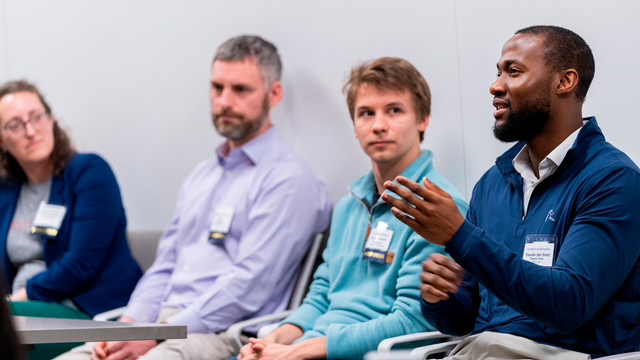
Students recently had the opportunity to learn about graduate school and career trajectories from those working in the scientific fields. Ten alums shared their stories and answered questions at “A Slice of Science” at the Gottwald Center for the Sciences.
“The goal of this program is to meet the needs of students studying science who have interests outside of healthcare and medicine,” said Brandy Ewell, assistant director for Career Services, which sponsored the program in collaboration with the Science Belonging Committee. “By inviting back alums working in life, physical, environmental, and data sciences, we hope students get a better sense of the variety of options.”
Many of the alums are working in cutting-edge technologies, including:
- Caitlin Bonney, a 2014 alum, a microgrid officer & strategy manager for Schneider Electric. She uses new technology to deploy microgrids across the U.S. to reduce carbon emissions and increase resilience. She majored in business administration with a minor in environmental studies.
- Class of 2024 alum Thando Tsela, a software engineer with RTS Labs, who implements AI solutions that help companies become more efficient and profitable. He was a double major in computer science and mathematical economics.
- Yibo Wang, a 2018 chemistry alum, who serves as a postdoctoral researcher in the at pharmaceutical company AstraZeneca and does formulation development and early developability assessment of biologics.
“I remember when I did research with Dr. John Warrick from the Department of Biology at UR. He really had a lot of hands-on training for me. I could ask questions, and Dr. Warrick would have the perfect answer for them,” Wang said. “That’s not always the case at grad school. You might not always get the same level of coaching or training.”
Hilary Fokwa, a graduate research assistant, recently earned her doctorate in chemistry from UNC Chapel Hill. Fokwa, a 2020 alum, urged students to spend their summers exploring different labs, to see what kind of research might interest them.
“If you go to a Ph.D. program, most have rotation programs, where you spend your first year conducting research with different professors,” Fokwa said. “It’s a really good way of figuring out what sort of chemistry you’re most interested in.”
She emphasized that undergraduate students should be proactive and take advantage of the Richmond Guarantee to pursue both on-campus research and summer opportunities at national labs, universities, or R&D divisions in the private sector.
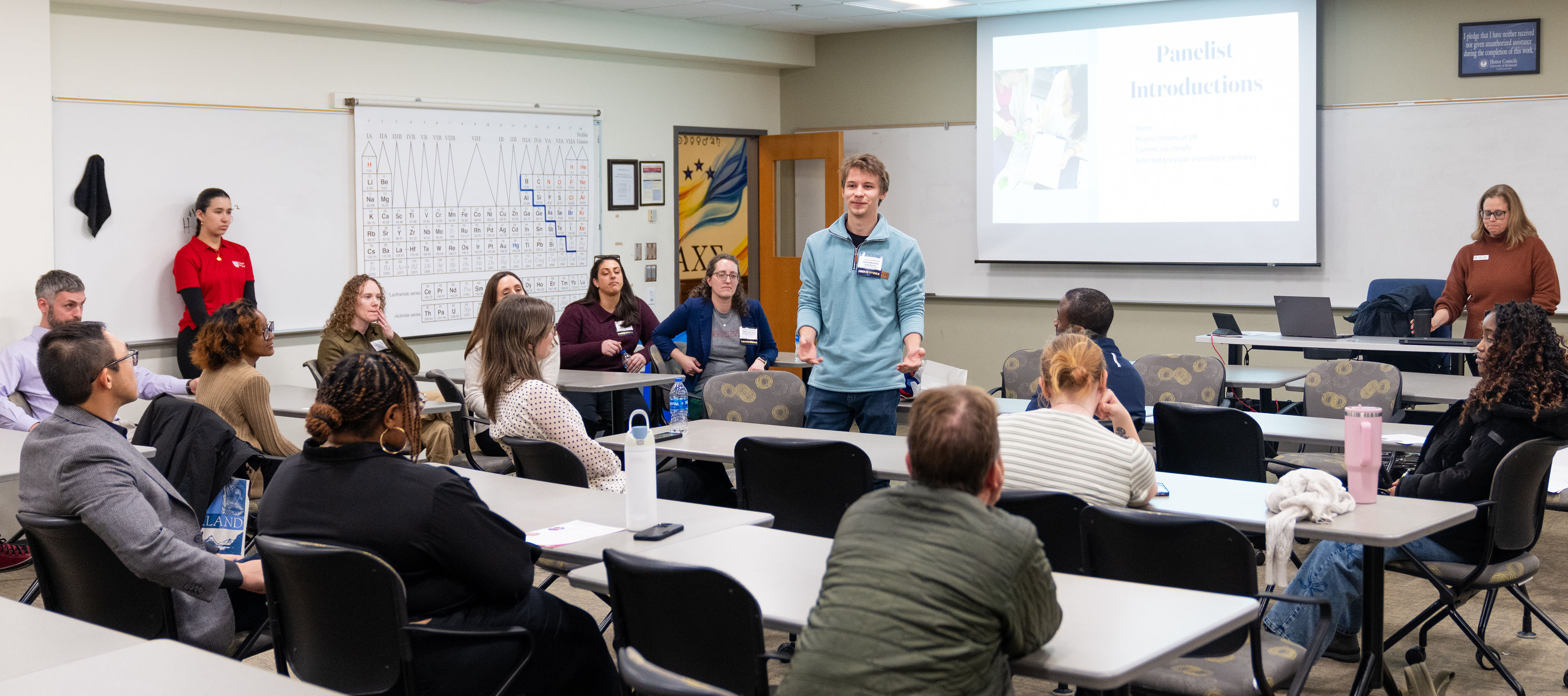
Some of the panelists didn’t follow a direct career path.
Jennifer Nock graduated from the University of Richmond in 1999 as a physics and chemistry double major. She earned her master’s degree in chemistry from Harvard University but then shifted gears and went to law school. Today, she is a patent attorney for Rothwell Figg in D.C.
“Get out of your comfort zone,” she advised the students.
Junior physics major Michael Bo enjoyed hearing about Nock’s journey, since he’s interested in going into patent law.
“She took a nonlinear path. It was nice to know there are alternative paths from going straight from bachelor's to law school, because I feel like I hear that a lot, but I don't know if it's the best path for everyone,” Bo said.
Senior Heidi Beal, a biology major and chemistry minor, attended the Life Sciences breakout session.
“I appreciated that one of the people on the panel didn’t have a Ph.D. or master’s degree, because I’m not planning to get one, at least for a couple of years,” Beal said. “It was also nice to hear that two of the alums took gap years before graduate school.”
“A Slice of Science” is a partner program to “Deconstructing Health,” a similar event held in the fall for Spiders interested in healthcare careers.
“The alums are overwhelmingly happy to be back on campus and to share their career stories and advice. They also often comment on the excellent questions students have for them,” Ewell said.
“Students tell us they really appreciate the alums taking the time to participate, and several say it helped relieve some of the stress they have over making career decisions.”