
Conversations about AI and the future of work take center stage at Richmond
University News
A range of perspectives presented during the annual Sharp Viewpoint Speaker Series prompted follow-up discussions inside and outside the classroom.
As University of Richmond senior Jodi-Anne Reid prepares to graduate this spring, she finds herself grappling with a question shared by students across the country: “How can I be a better job candidate in the age of AI?” She put that question directly to two of the nation’s leading economists, David Autor and Anton Korinek, scholars who are shaping global conversations on the future of work in the age of artificial intelligence.
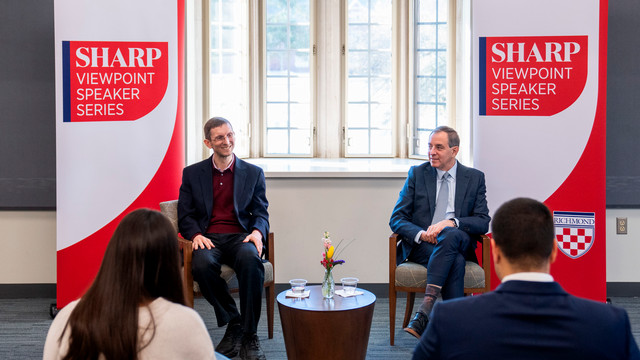
Reid, a business administration major who is taking a “Gen AI” class with economics professor Saif Mehkari, was one of 12 students who had the opportunity to attend a student engagement session with Autor and Korinek, the speakers of this year’s Sharp Viewpoint Speaker Series event, “AI and The Future of Work.”
Reid plans to pursue a career in a marketing-related field. She is interested in how AI can enhance her creativity but also concerned about its impact on the job market. Although Autor and Korinek both suggested that learning about AI and developing AI skills would make job candidates valuable, they hold markedly different and eye-opening perspectives on this evolving topic.
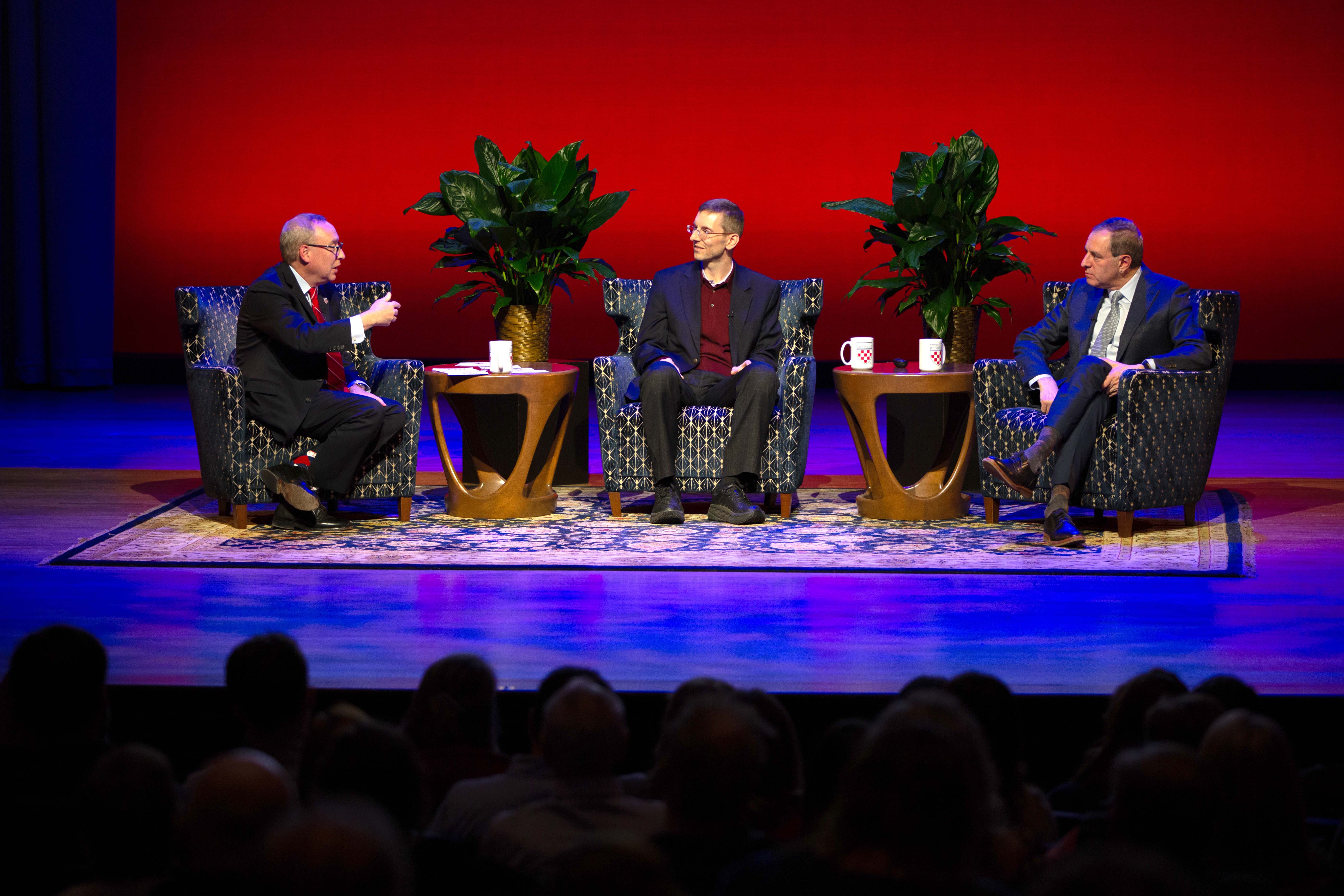
The students, including Reid, later joined a near-capacity crowd of about 350 students, staff, faculty, and community members for the main event held in the Modlin Center for the Arts' Camp Concert Hall.
Autor, a professor at the Massachusetts Institute of Technology studies how technology reshapes labor markets, including job polarization and inequality. Autor encourages both hope and realism.
“We should certainly be both optimistic and pessimistic at the same time,” Autor said. “I truly believe that AI can complement supporting tasks and make them more efficient, and we are at the dawn of possibilities. I’m particularly interested in how AI can enhance the middle class in opening new opportunities for expertise and skills.”
Autor also pointed out that even powerful new technologies take decades to diffuse fully, so labor shifts across sectors will likely unfold gradually.
Korinek, a professor at the University of Virginia’s Darden School of Business, was named to the 2025 TIME100 AI list of the most influential people in artificial intelligence. His research focuses on the economics of transformative AI and its long-term implications for society and public policy. His view on the impact of AI is less optimistic than Autor’s.
Because machines can learn both quickly and cheaply, Korinek said changes could be swift and lead to fewer jobs being available.
“We are living through the AI take-off right now, and this may accelerate the labor share decline significantly as AI learns and can do more and more human skills,” Korinek said.
Autor and Korinek each presented their points briefly at the start of the event, then had a civil debate during a follow-up question and answer period moderated by University of Richmond President and Distinguished University Professor of Economics Kevin F. Hallock.
“What people do that is valuable is they translate formal knowledge to human interaction,” Autor said.
“The extent of uncertainty and possibility is larger than it has been for the past half century,” said Korinek. “Yes, AI’s influence could be more like the internet, especially if we embrace it responsibly, but it could also be a force multiplier and take off in ways we can’t yet imagine.”
Autor and Korinek agreed that learning as much as we can about AI, learning how to use AI, and speaking up about how we want AI to impact the future are important.
Jepson School of Leadership Studies professor Volha (Olga) Chykina attended the event with students from her Educational Policy and Politics Across the World course.
“This event complemented a theme of the course that centers on education-to-work transitions by highlighting how AI is reshaping labor markets,” said Chykina. “My students and I can have a great follow-up discussion about how AI-driven changes in the future of work influence education systems, skill formation, and policy debates across different national contexts.”
Follow-up discussions also continued elsewhere on campus.
A campus conversation the following day focused on this question: Does a change in work necessitate a change in a liberal arts education? Participants debriefed on the Sharp Series event and further discussed how an academic community can flourish and achieve their educational mission in an AI-enabled world. The event was hosted by UR’s participants in the American Association of Colleges and Universities Institute on AI, Curriculum, and Pedagogy in collaboration with the Office of the President, Office of the Provost, Career Services & Development, and Center for Liberal Arts and AI.