
A University of Richmond theatre professor takes his curtain call
University News
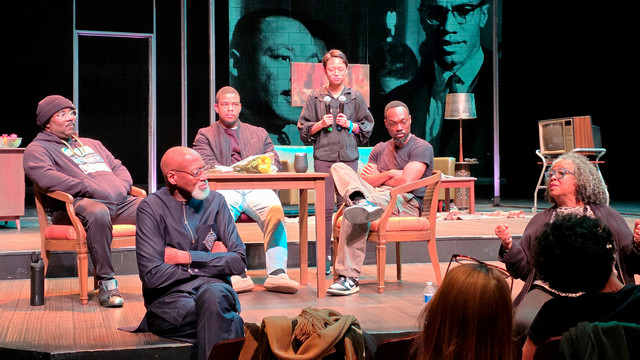
Set in a seventh-floor room in a Harlem hotel, The Meeting, a fictional encounter between Malcolm X and Martin Luther King Jr. was one of the last plays theatre professor emeritus Chuck Mike directed before his recent retirement.
Mike noted that although the two men had different ideologies, they resolved to have mutual respect and love for each other.
“Their meeting was emblematic of how dialogue is the first step in making change. The play provided a powerful lesson in how and why dialogue is crucial to forging a better humanity,” Mike said. “I hope audiences were inspired to take action that leads to a more humane society.”
Mike first presented The Meeting at UR in 2008. He brought it back in November as part of his “Triple Play & I’m On My Way” farewell tour, which also included a staged reading in December of his theatrical memoir, Omowale (which in Yoruba means the “child who has come home”). Both events were sold out.
“Chuck Mike has been instrumental in bringing the healing power of theater for social change to the University of Richmond both as a committed educator and as a brilliant director,” said dance professor Alicia Díaz.
He has been hired to direct an open mic session, Extrordinoir: A Celebration of Black Voices, which will debut on Feb. 26 at Tyler Haynes Commons.
Subject matter meant to evoke thought
Mike doesn't shy away from controversy. At The Meeting, signs warned that some material might be disturbing to some audience members.
“They have a choice of entering or not,” Mike said. “The role of theater is not just to entertain, but also to educate and enlighten, and often this process leads to emotive and challenging experiences. That is what theatre does, and that is what we teach our students.”
Mike grew up in the ’60s and ’70s and recalls his parents attending civil rights protests. “I was highly influenced by King’s message of love. I was also deeply captivated by Malcolm’s fiery rhetoric and the community self-defense movement of the Black Panthers,” he said.
Details about his early years were covered in Omowale, a theatrical memoir he began writing in France last summer while on sabbatical as a Camargo Foundation Fellow. The play explores his childhood in Brooklyn, New York, where he was born, and his journey from the U.S. to Nigeria in January 1976 as a Fulbright/ITT graduate student.
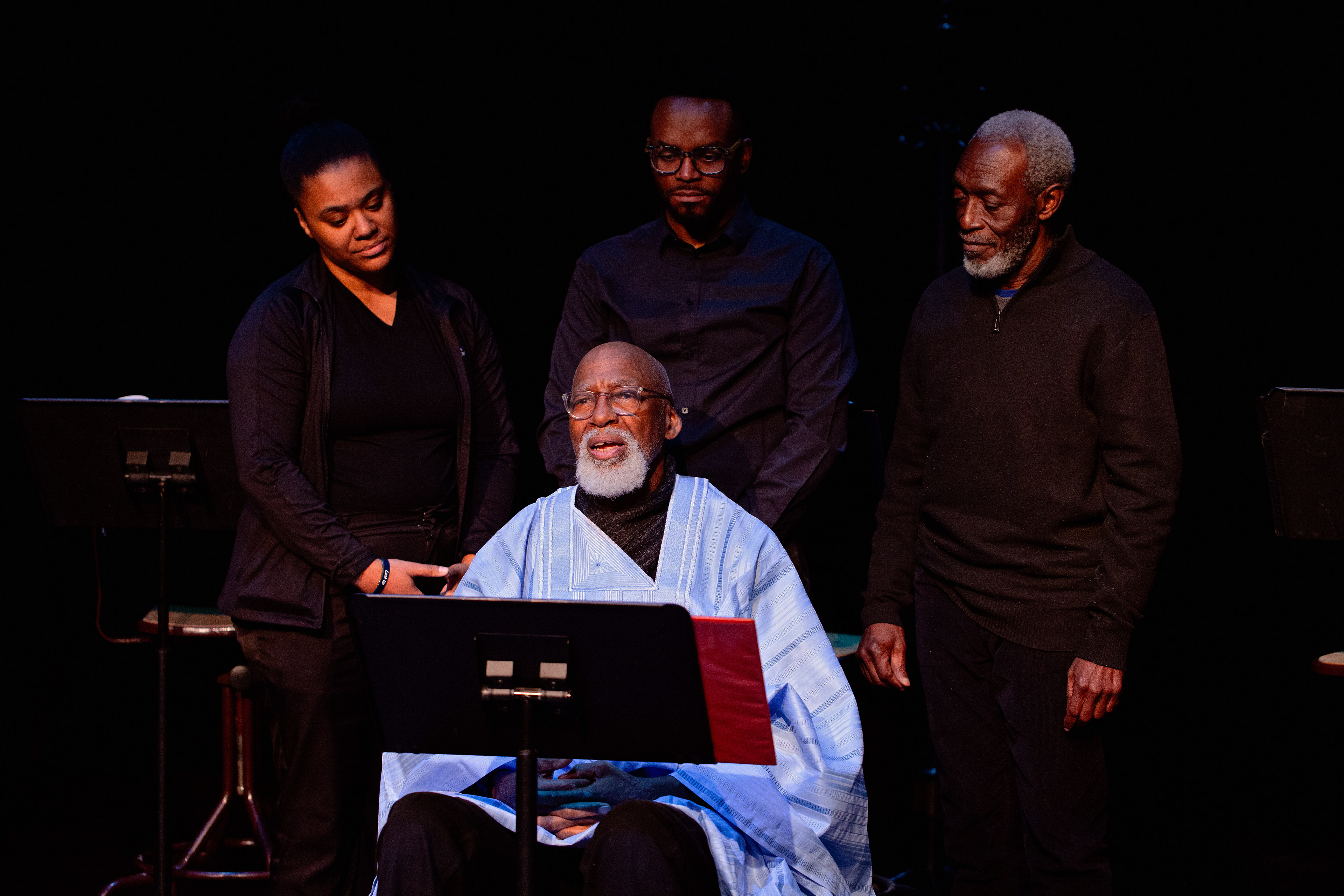
Chuck Mike dons a blue Agbada robe, a West African robe worn by men, at the end of Omowale. He is surrounded by community actors (l to r) Zakiyyah Jackson, 2005 UR alum Durron Tyre, and Ihria Enakimio. “It was a cathartic moment. I could feel my ancestors present,” said Mike.
An accomplished life
Mike has acted at the Lincoln Center for the Performing Arts and toured with Collective Artistes of London. His work has been staged in the West End of London, the Royal Court Theatre, and the Kennedy Center, to name a few. He’s received grants from the Ford Foundation and the MacArthur Foundation to support his work.
He was scheduled to spend a year in Nigeria, but ended up staying almost 30 years, meeting his wife and having two children there. While abroad, Mike was mentored by Nigerian playwright Wole Soyinka, the first African to win the Nobel Prize in Literature. He also founded two theaters in Lagos.
On returning to Nigeria from a UK tour in 2004, he found a letter waiting for him from UR Theatre & Dance search committee chair Dorothy Holland, who’d heard about his work. “The department was looking for someone to teach African and/or African American theatre,” he said. “It was perfect.” He started working at UR in January 2005.
“Chuck’s work has always made space for conversation, inviting students and audiences into dialogue that connected what we saw onstage to the world we live in,” said theatre professor Patricia Herrera. “He reminds us that theatre isn’t something we do for art’s sake alone, but something we use to reflect, to resist, and to repair.”
He reminds us that theatre isn’t something we do for art’s sake alone, but something we use to reflect, to resist, and to repair.”