
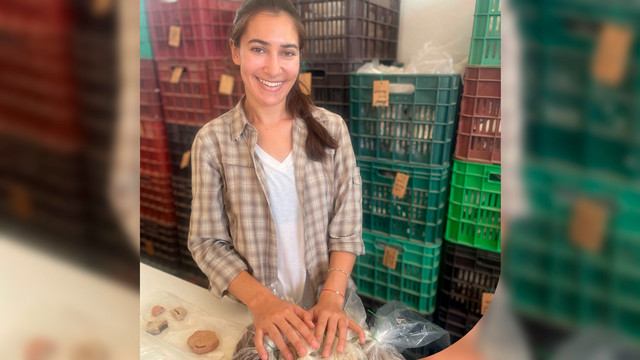
Ancient artifacts helped shape this University of Richmond alum’s future
Alumni
When Janelle Sadarananda enrolled at the University of Richmond, she didn’t expect that her undergraduate years would include vacuuming an ancient Egyptian mummy buried in ca. 600 BCE. “How many people, when they’re 20 years old, have participated in the conservation of a mummy and her sarcophagus?” said Sadarananda, a 2013 graduate who majored in classical civilization and minored in archaeology. “I never imagined that would be something I’d get to do in my whole life.”
That extraordinary experience — preserving the remains of Ti Ameny Net alongside conservator Chris Wilkins and 2014 UR graduate Miriam Hiebert, a chemistry major at the time — further sparked Sadarananda’s lifelong passion for archaeology. Now an assistant teaching professor and associate chair of Classics at Skidmore College, she said the project outlined the path for her research career and for how she approaches the material culture of the ancient world.
Sadarananda’s interest in archaeology began at Richmond with a first-semester introductory course taught by Elizabeth Baughan, an associate professor, who soon invited the young student to apply to join her fieldwork team in southwestern Turkey. Over three summers, with assistance from A&S summer research fellowships, Sadarananda worked with Baughan at Hacımusalar Höyük, a mound site preserving thousands of years of human occupation.
“It was an incredible opportunity,” she said. “We were part of a small research team doing the real work.”
In her first summer, Sadarananda excavated Early Bronze Age domestic structures. “People always expect archaeologists to find gold,” she said. “But I was thrilled to find mud bricks with reed impressions from a collapsed roof.”
She also managed cataloging and database work. “I got to see everything, from Bronze Age to Byzantine artifacts. It made the past feel alive.”
How many people have participated in the conservation of a mummy and her sarcophagus?”
Caring for Ti Ameny Net
In her senior year, Sadarananda’s independent study focused on the university’s Egyptian mummy, Ti Ameny Net and her coffin. The mummy had been at Richmond since 1876. Centuries of handling and storage had loosened wrappings and left white crystalline deposits on exposed skin.
“She had been transported from Egypt to Richmond, and the lore is that at one point she was stored improperly,” Sadarananda said. “Her wrappings were coming undone, and there was this white, powdery efflorescence on her skin. Obviously, we didn’t want her to deteriorate.”
Under a professional conservator’s supervision, Sadarananda helped stabilize and clean the mummy and restore sections of her coffin. “We actually vacuumed her, very gently, with pantyhose over the nozzle so we wouldn’t lose any material,” she said. “Then we used Japanese tissue paper and a special adhesive that can be reversed to reattach fraying wrappings.”
The work also meant filling cracks in the wood. “We used syringes to inject the fills, then learned about inpainting so that our repairs looked cohesive but still recognizable as modern,” she said. “You don’t want to lie to the viewer and make it look like everything is ancient and perfect. Conservation is about honesty and respect.”
Just as formative were the conversations around ethics. “We talked a lot about how Ti Ameny Net is a person, not an object,” Sadarananda said. “That’s why we called her by name. Even the language we used mattered.”
Those discussions, she added, “prepared me for the kinds of ethical debates archaeologists are having now about displaying human remains and respecting different cultural and religious perspectives.”
Science, Art, and the Ancient World
Sadarananda carried that blend of technique and reflection into graduate school at the University of Pennsylvania, where she earned a Ph.D. in Art and Archaeology of the Mediterranean World. Today, her research uses scientific methods to study ancient ceramics.
Using ceramic petrography, she examines thin sections of pottery to identify minerals, clay sources, and manufacturing choices. “It’s like geological detective work,” she said. “You can see if potters mixed clays, added temper, or processed the material in certain ways. These decisions tell us how communities worked, learned, and exchanged knowledge.”
One of her ongoing projects focuses on pots from a small region of ancient Greece.
Looking back, Sadarananda credits Richmond with giving her confidence and preparation for that academic path, particularly for its liberal arts emphasis that allowed her to connect different disciplines. “I loved both science and the humanities, and Richmond showed me I didn’t have to choose between them,” she said. “The mentorship was phenomenal. That’s why I was able to become a professor. I want to give my students that same blend of curiosity and support.”
This past November, Sadarananda returned to campus to share her current research in Mediterranean archaeology. “Everything I do now traces back to the opportunities I had at Richmond — the fieldwork, the independent study, the conversations that shaped how I see the ancient world,” she said.
Even after a decade of research, teaching and excavation, her appreciation for those formative experiences endures. “Richmond prepared me not just for graduate school or a job,” she said, “but to be a thoughtful person in the world.”