
Richmond researchers impact a neighborhood one tree at a time
University News
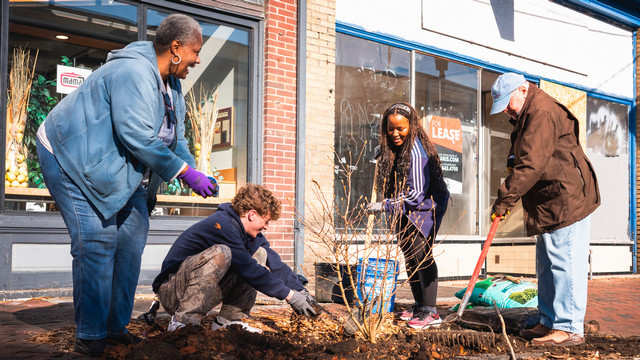
A few dozen people from the University and the Richmond community came together to plant trees — three Chinese pistache and two star magnolias — during Richmond Tree Week in November. The project builds on three years of collaborative work between the Historic Jackson Ward Association and UR’s Spatial Analysis Lab.
“Each year, we engage with the community to identify ways our spatial data science expertise can address community needs,” said Kyle Redican, teaching faculty of geography, environment, and sustainability and director of the Spatial Analysis Lab. This year, residents identified Jackson Ward's urban heat island — a place that is significantly warmer than surrounding areas, because green spaces are replaced with asphalt and concrete and heat is released from traffic and nearby industry — as a pressing concern.
Senior Thuba Mnisi was part of the student research team that helped plant trees in vacant tree wells to provide more shade. Most of the areas were easy to clear, she said, but some required extra staffing to break through the clay and the roots growing beneath the sidewalks.
“Putting the trees into the dirt was so cathartic and instantly livened up the streets,” said Mnisi, a health studies and geography double major. “It'll be beautiful to see how they look in full bloom in the years to come.”
Residents will see early shade and some cooling benefits over the next 5 to 8 years, with increasingly stronger temperature impacts as the trees continue to mature.
We envisioned this day and did all the preparatory work, but actually being there, digging in the dirt to create positive change, made everything worthwhile."

Research conducted during the summer
Mnisi and seniors Kay Lina and Patrick Stapleton, along with sophomores Donovan Murray and Julia Weiner, took part in a summer research fellowship led by Redican and Beth Zizzamia, GIS operations manager for the Spatial Analysis Lab, that explored micro-climate approaches to neighborhood heat.
During June 2025's heat wave, students collected temperature data every 50 meters for five days. They measured both sidewalk heat and wet-bulb temperatures, which gauge the effects of heat and humidity on the body's ability to cool itself through perspiration. To mitigate heat, they identified vacant tree wells in the neighborhood's hottest areas for the plantings.

“However, identifying locations wasn't sufficient. We needed community input and expert consultation,” Redican said. At Historic Jackson Ward Association meetings, residents specified that trees planted should be low pollen, have non-invasive root systems, and be hardy enough to survive.
“Working with city arborists, we selected trees meeting these community requirements,” Redican said.
More than words on a page
The students worked closely with the community, going on neighborhood walking tours, exploring the Richmond Public Library’s memory lab and the Black History Museum, learning from the Ealey Project about civil rights attorney Roland J. “Duke” Ealey, who helped integrate Richmond Public Schools, and getting input from members of the Historic Jackson Ward Association. “These experiences transformed Jackson Ward from a study area into a real place with real people. These folks became our friends and community partners,” said Redican.
Along with the trees, the students suggested placing commemorative plaques featuring quotes from famous neighborhood residents, such as Maggie L. Walker, Bill “Bojangles” Robinson, and William Washington Browne.
“The community of Jackson Ward has been so vital to the prosperity of Richmond for generations and will continue to be a pillar of strength and resilience for the city,” Mnisi said. “We wanted to capture the words of Jackson Ward icons that have helped shape the neighborhood's significant history.”
“The highlight of the day was seeing the results of our research project and long-discussed plans come to fruition,” said Stapleton.
Redican agreed.
“During the summer, we envisioned this day and did all the preparatory work, but actually being there, digging in the dirt to create positive change, made everything worthwhile,” he said.