
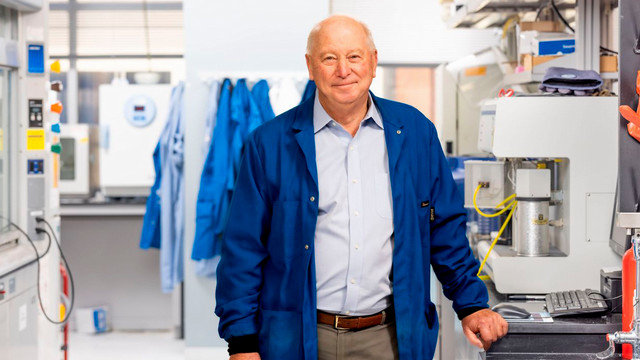
Richmond alum Frank Gupton makes lifesaving medicine more accessible
ALUMNI
This award-winning scholar and industry expert is dedicated to improving global health by making pharmaceuticals more affordable.
Frank Gupton, a 1973 UR alum, didn’t originally come to the University of Richmond intending to become a chemist. He came to play basketball because he received a scholarship. “But I realized during my first year that I wasn’t going to be able to make a living out of playing basketball, so I needed to start studying.”
The Floyd D. Gottwald Jr. Chair in Pharmaceutical Engineering, professor and chair of the chemical and life science engineering department at Virginia Commonwealth University now laughs about the pivot. “I was initially reluctant to take a chemistry course because I had done so poorly at it in high school,” he said. But chemistry professor Richard “Dick” Topham helped Gupton connect with the subject. He earned an A at the end of Topham’s course in his sophomore year. Then Topham asked Gupton to join him in the research lab, and that changed everything. “I saw that chemistry was actually fun,” he said, “and that I could take what I learned in the classroom and apply it to real-world problems.”
After graduating from UR, Gupton considered his next move, possibly joining his older brother John at the Georgia Institute of Technology graduate school to study chemistry, where John was pursuing his master’s and Ph.D. “I was considering several graduate programs at the time and Georgia Tech offered the most competitive financial package, so, I went to Georgia Tech,” he said. “The fact that my brother was there made it even more attractive.”
Decades later, the connection between Gupton and Topham resurfaced when his brother John joined the University of Richmond’s chemistry department, later becoming department chair.
A Mission to Make Medicine Affordable
After graduate school, Gupton’s research career took him from the commodity chemical industry to global pharmaceuticals. “The thing that differentiated me from many others in pharmaceutical R&D is that I started out in a sector of the chemical industry that was always thinking about cost,” he said. “When you’re in the commodity chemical industry, the profit margins are tight, so you have to design cost out of the process.”
That mindset shaped his later work developing drugs to treat HIV. “While I was at Boehringer Ingelheim, a pharmaceutical company, we launched Nevirapine, the second HIV drug ever approved by the FDA,” he said. “It was approved in two weeks and was the fastest drug approval in FDA history because there was such an urgent need. It ended up being used in all the combination drug therapies for HIV and was a tremendous success.”
After retirement from the business sector in 2008, Gupton transitioned into academia, joining VCU as chair of the chemical and life science engineering department with a joint appointment in the department of chemistry. During this period, he received an initial grant from the Bill and Melinda Gates Foundation to reduce the cost and amount of waste it took to make Nevirapine.
“We were able to reduce the cost of the drug by more than 60% and we cut the amount of waste in the process from 80 kilograms per kilogram of product to four,” he said. The dramatic waste reduction was recognized by the EPA and Gupton won a Presidential Award for Green Chemistry.
His current work focuses on a complicated molecule that could lead to a once- or twice-yearly injection that holds the promise as a cure for HIV.
“Now we’re working on access to therapies for rare diseases,” he said. Today, developing a single drug costs $2.5 billion, with a company having less than a decade to recoup that cost — leading to those high market costs. Gupton’s team looks at how to trim costs in starting materials, low-yielding reactions, or even the consolidation of long processes.
“It’s great to have the medicine,” he said. “But it must be produced efficiently with a robust supply chain and, ultimately, it must be affordable.”
Teaching as Legacy
These days, Gupton spends up to a third of his time in the lab, where his research team, mostly students, totals about 40. In his Process Design course students learn not just chemistry but business. “They run mock companies, design processes, do cost estimates,” he said. “It’s about giving them the skills they’ll need in the real world.”
His philosophy on teaching echoes the lessons he learned at Richmond. “I tell my students that something being hard isn’t necessarily bad,” he said. “Organic chemistry isn’t something people tend to migrate toward, but when you present it in a way that matches how they learn, they realize they can do it. And that’s when it gets fun.”
Asked when he might finally retire again, Gupton smiled. “I turned 75 this year,” he said. “I keep three things in mind: how many students I still have to mentor in the lab, whether I’m adding value to their education, and whether it’s still fun. Right now, the answers are yes.”