
University of Richmond’s new business school dean emphasizes the importance of learning the fundamentals in the age of AI
University News
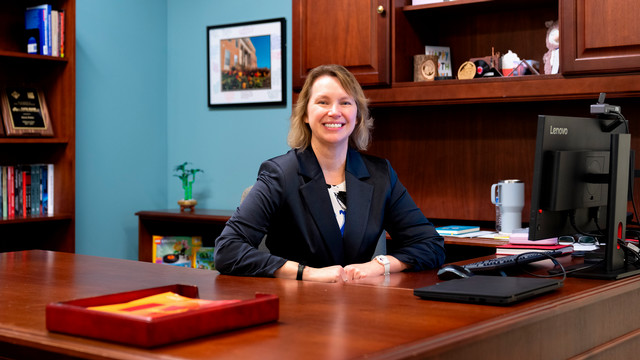
Stacie Petter is in her first semester as dean of the Robins School of Business. With a background that blends technology, information systems, and business, she brings a nuanced perspective to how students can approach their business education in an everchanging environment.
You’ve been at the University of Richmond for a few months. How’s it going?
It’s going really well. I do feel like everyone keeps asking me if I'm settled, and in some ways weirdly I kind of feel like I am. It feels like I’ve been here a lot longer than just three months. It feels very comfortable and like it fits.
I feel very fortunate to be able to walk into a place that already has that strong of a sense of community and that strong of a foundation. There’s already so much momentum, so much excitement, and a lot of innovative programs. They’re not because of me. They've already been in place. We have such a strong and committed faculty. We have a student body who is really engaged, and we have an alumni base who just — gosh, Spiders want to help Spiders. It is remarkable how engaged and connected they are. That allows us to figure out what are the other great things that we can do together.
It’s important to recognize and honor the past and all the work that has been put in place to be able to then think through “OK, what’s next for us?” and that’s exciting.
You’ve lived and taught in different parts of the country — what are you excited to do in Richmond?
I’m also a bit of a of a history nerd in some respects. I always like to learn. I'm from Atlanta originally — which obviously has some history — but Richmond’s a much older city and has an interesting, complicated history. That’s the part I’m looking forward to getting out and exploring.
It also feels like there’s no excuse not to be active in the city. I want to start figuring out those routines or different things that I can do to keep exploring the city in a more active way.
AI is a huge topic everywhere. How do you think the Robins school can help students prepare for AI in the workplace and their lives before they graduate?
It’s by making sure we’re not preparing students just for the current technology of the moment — which happens to be generative AI — but thinking about what’s next and how to evaluate other types of innovations.
In conversations that I have with alumni or even students or parents, the common thing I’ll hear is, “Students should take an AI test,” or, “They should demonstrate AI proficiency by completing a class.” They want to check a box, and my response is, “I disagree.” It’s not, “I learned a tool and now I’m done,” which is what that check-a-box feels like. It’s, “I know how to apply. I know when is the right use case for it. I know how to use it in this circumstance and how to adapt my learning in another circumstance.”
There will always be another tool. They can then use similar processes to be able to say, “Oh, yeah, I did that with AI. I can do it with the next thing,” whatever that is. It doesn’t feel as foreign to them.
Students are here to learn — and to learn how to learn.

AI is changing a lot of things, but a lot of things aren’t changing. What continues to be true about what business students need to know?
Two key things here. One is that students have to make sure that they understand the fundamentals of their discipline inside and out. The challenge of AI is it will give you an answer, but it doesn’t mean it’s a good answer. That’s where you need to have a good understanding of the fundamentals and have a good baseline to be able to evaluate, “Is it a good answer?”
But it’s more important to learn how to learn. Students are here to learn — and to learn how to learn.
I have often said that I am learning every day, and that is true, but part of that is I am struggling every day, right? It’s having to stretch and grow and be uncomfortable with the uncomfortable, and that is another important piece for our students to recognize.
What’s something alumni should know about you?
I think it’s important for folks to know that I’m very open to hearing ideas and exploring possibilities. It would be foolish to come in saying I know exactly what the University of Richmond and the Robins School of Business needs. I don't know what it needs until I listen and understand where the opportunities, the challenges, and the passions are.
I want to know what’s working among our students and what we’re helping our students with as they get prepared for the workplace. We want to make sure that we're helping our students get the skills that they need, and we want to make sure our alumni are feeling like they can be connected to our students and to their alma mater in whatever way they want to be connected.